Selected work / Independent themed entertainment exploration
Avengers: Endgame Experience
An independent exploration of storytelling, experience design, and the Imagineer who's been hiding inside the designer all along.
Personal concept / Exploratory workStory · Guest experience · World-building
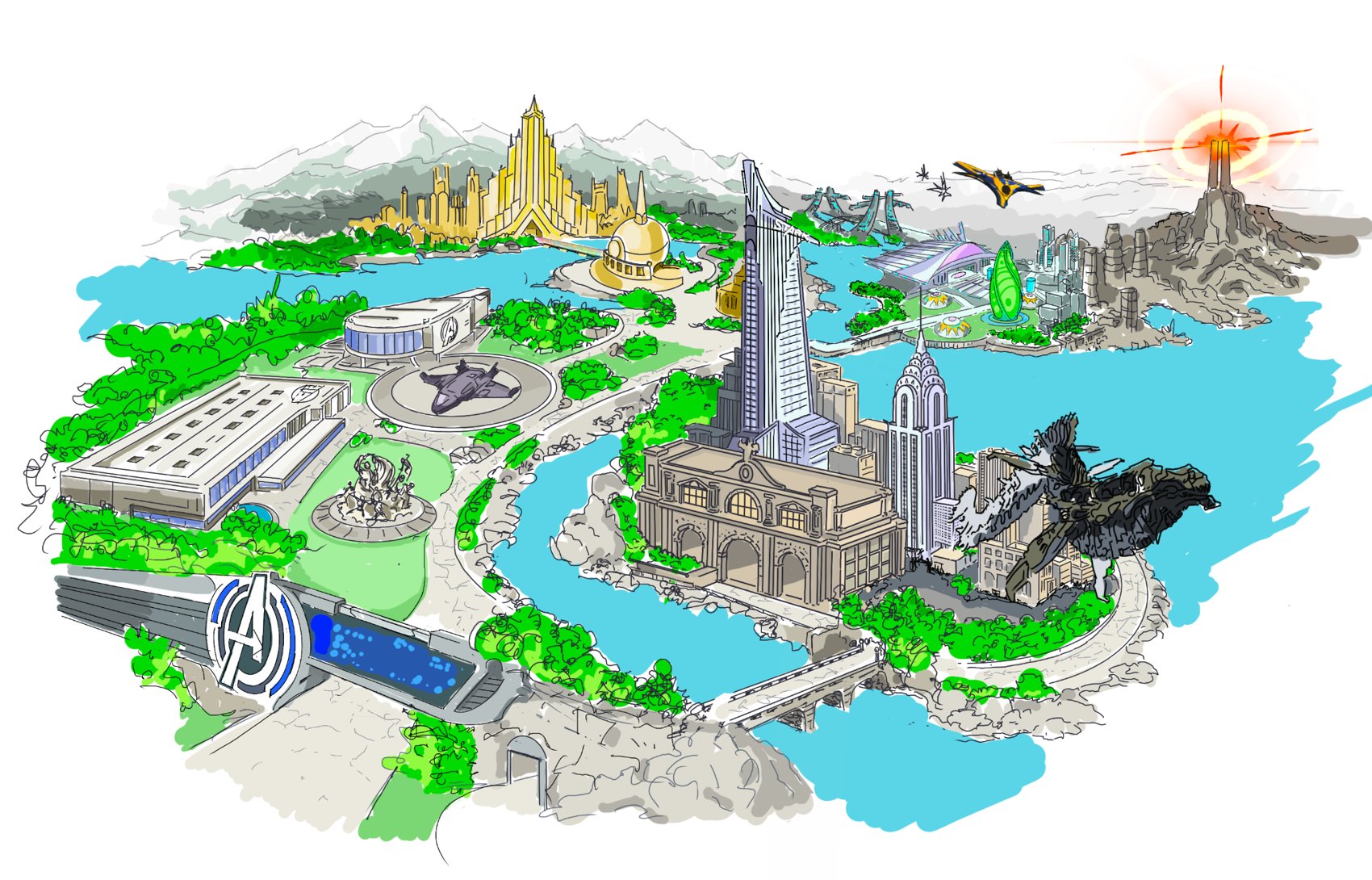
Avengers: Endgame Experience / Original concept illustration by Frank Marchese
Chapter 01 / Origins
It started with two things I love.
I've loved theme parks for as long as I can remember. Not just the rides, but the worlds they create. The anticipation that starts to build before you've even scheduled your trip. When you finally step through the entrance, you've arrived somewhere magical. The architecture, music, lighting, storytelling, and countless little details can come together to make you forget, if only for a while, that the world outside still exists.
At eleven, two weeks' worth of allowance bought me my first comic book. I've been hooked ever since. Superheroes have been part of my life since childhood, and I've never really outgrown my fascination with their stories, their heroism, or the worlds they strive to protect.
For most of my life, those two passions existed side by side.
Then I had a chance to bring them together.
Early in my journey to figure out what this whole "themed entertainment" industry was all about, I discovered Imagineering in a Box—an online course exploring how themed experiences are conceived and developed. One of its exercises invited participants to choose a story they loved and imagine how they might bring it to life.
I chose Avengers: Endgame.
For me, the film represented something extraordinary: the culmination of more than a decade of interconnected storytelling, featuring characters I'd known and loved for much of my life.
But I didn't choose Endgame simply because it's one of my favorite movies.
I chose it because of how it makes me feel.
I've watched it more times than I can count, and certain moments still get my heart racing. Others still make me laugh. And some just make me cry like a baby. After all these years, and all those viewings, the story still has that power over me.
Without realizing it, I'd begun creating a themed experience that could make other people feel those things, too—not just fans who knew every character and every line of dialogue, but anyone who walked through the gates. It had become far more than retelling a story. It was truly about delivering an experience.
I wanted guests to become part of this world, experience the drama and excitement, feel the emotional weight of its most powerful moments, and revel in the heroism of its protagonists. And I wanted the care behind the experience itself—the storytelling, the environments, the attractions, and the smallest details—to give them something new to fall in love with.
I didn't want to simply pay tribute to a story I love.
I wanted to share what it feels like to love it.
What began as a course exercise gradually became something much bigger: an independent exploration of an entire themed entertainment destination, complete with interconnected lands, attraction narratives, environmental details, guest experiences, and more questions than I ever imagined I'd be asking.
There was no client. No commission. No expectation that any of it would ever be built.
Just a chance to dream.
And I took it.
Chapter 02 / Narrative
The challenge wasn’t recreating the movie.
My first instinct was to recreate scenes from Endgame. But the Russo brothers had created such a compelling film that it had already been seen by an estimated 250-300 million people worldwide. Nobody would plan a vacation to see it.
They'd plan a vacation to experience it.
The challenge, as I saw it, was figuring out how to let guests participate in a familiar story without disrupting the events that made it meaningful in the first place.
That became one of my most important creative constraints.
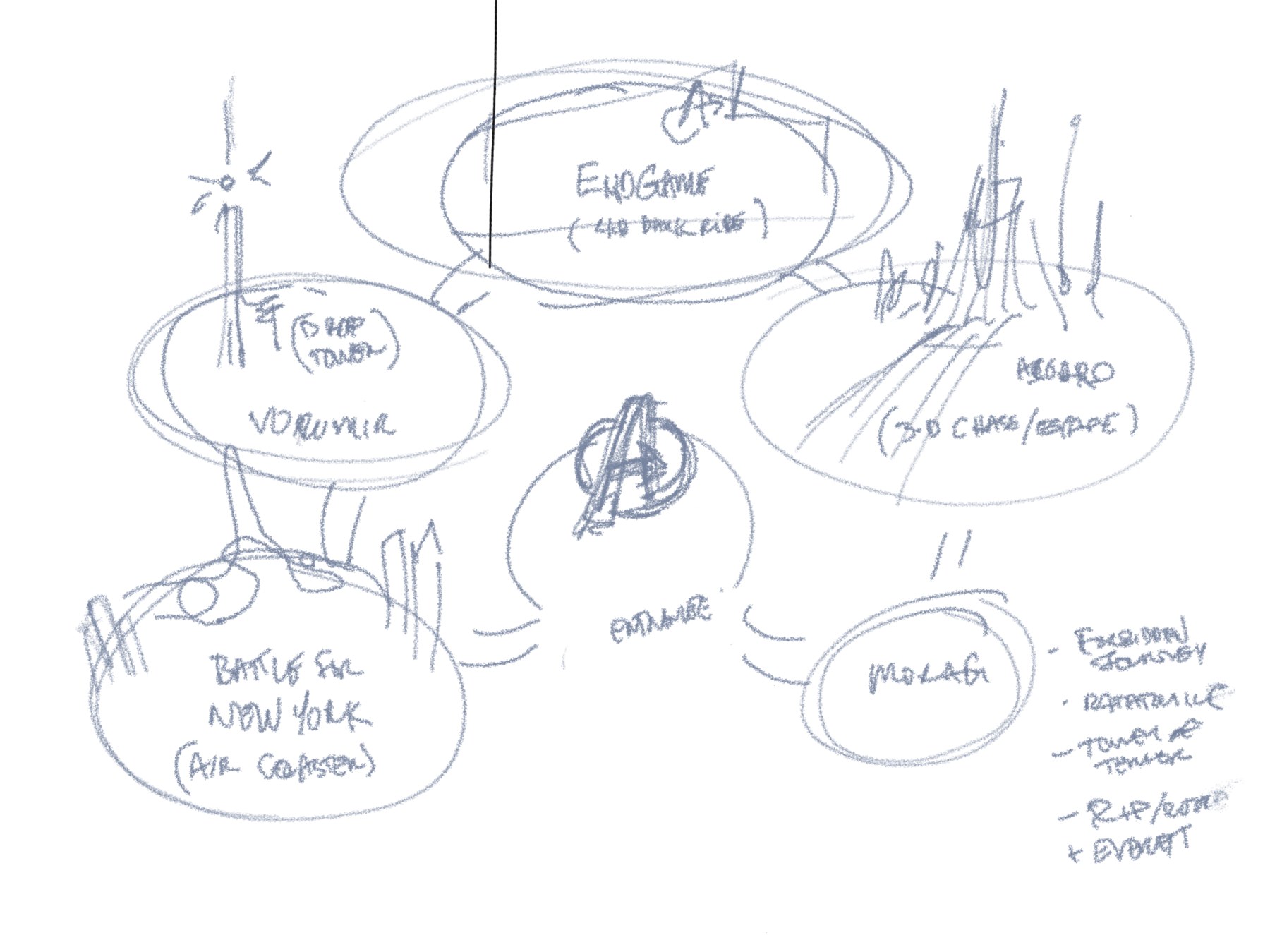
The park's premise grew out of the Time Heist. Guests would arrive at Avengers Campus as prospective recruits, invited to prove they've got what it takes, by going back in time and helping the Avengers recover the Infinity Stones.
From there, they could brave New York during the Chitauri invasion, cross the rainbow bridge to Asgard, venture into the alien environments of Morag and Vormir, and ultimately join the battle against Thanos.
But I didn't want guests to replace the heroes or change the outcome of the story. I wanted to establish meaningful roles for them within it.
In New York, for example, guests could join Tony Stark's Iron Legion, flying through the chaos of the Chitauri invasion while the familiar events of the Battle of New York unfolded around them.
On Morag, guests could help protect an oblivious, dancing Peter Quill from threats he doesn't even realize are there, giving Rhodey and Nebula the opportunity to retrieve the Power Stone.
And in Asgard, an attraction centered on Rocket's mission to retrieve the Aether could weave humor, danger, and spectacle around one of the film's most intimate moments: Thor's unexpected reunion with his mother, Frigga.
That scene presented a particular challenge. It's a deeply personal moment between two characters. How could guests witness it without disrupting the emotional weight of the exchange?
My solution was to have Loki open a magical portal through which guests glimpse the end of their conversation. Frigga delivers her familiar words of wisdom to Thor, then gives the riders a knowing wink. Loki gasps, palace guards burst into the dungeon, and Rocket seizes the opportunity to escape.
The guests haven't changed the meaning or outcome of the scene. They've simply experienced it from a different perspective, with a brief acknowledgment that makes them feel part of the world.
It was a small detail in the context of a much larger attraction. But to me, those are exactly the details that matter.
Being part of a beloved story shouldn't mean getting in the way of it. Every ride, attraction, spectacle, or simple prop a guest would encounter in the park had to follow that premise.
Chapter 03 / World-building
Building a world, not just a collection of rides.
As the project grew, I found myself thinking beyond the headline attractions.
What would it actually feel like to stand in these places? What would guests hear, see, and notice when they weren't riding anything? How would the environments, characters, food, merchandise, and smaller experiences reinforce the larger narrative? How would they vary from one land to the next?
In New York, the city would be under attack. Sirens, distant explosions, the odor of burning rubble, and the reactions of people on the street would make the invasion feel like something happening all around the guest—not just inside a ride building.
Asgard would offer a completely different atmosphere: golden architecture, ceremonial music, the Bifrost, the World Tree, royal halls, and opportunities for mischief with Loki.
Morag would be strange, unpredictable, and a little ridiculous, while Vormir would carry the weight and unease appropriate to its place in the story. Realizing neither location would comfortably sustain visitors for long, Xandar was introduced as a jumping-off point for the Milano to shuttle Avenger-hopefuls to either destination.
Back at Avengers Campus, guests could encounter the headquarters, training areas, the Quinjet, and familiar objects connected to the Time Heist. Quieter spaces, including a memorial garden, would give the environment emotional depth beyond its action sequences.
I also began imagining smaller activities for younger guests: testing their worthiness with Mjolnir, practicing Hawkeye's archery, trying Captain America's shield toss, building virtual Iron Man armor, or dancing with Groot. Okay, maybe not just for younger guests. We all want to dance with Groot...
These weren't all fully developed concepts. Some were little more than notes. But they came from the same question: what else would make this world feel alive?
I wanted the park to reward curiosity, whether someone spent five minutes passing through an environment or an hour exploring its details.
Chapter 04 / Guest experience
A good story doesn’t always make a good guest journey.
One of my earliest ideas was to make the Time Heist a progression-based experience.
Guests would collect the Infinity Stones by completing missions in the various lands. A wearable time / space GPS, alerting them each time they collected a stone would be a can't-miss merchandising opportunity. Only after collecting them all would they unlock access to the final battle.
It made perfect sense from a storytelling perspective.
It made considerably less sense from an operational one.
I began imagining what would happen when, after completing their other missions, a large number of guests started converging on a single attraction toward the end of the day. The queue line stretched for a mile. The fight between Earth's Mightiest Heroes and the armies of Thanos would pale in comparison to the angry crowds still waiting in line hours after the park closed for the night.
And the more I thought about it, the more I realized there was a second problem.
Not every guest would want to experience the park in the same way.
Families with young children might prefer the lighter experiences and avoid the intensity of Vormir. Thrill-seekers might want to ride Battle for New York three times in a row. Some guests might pursue every mission, while others would be perfectly happy exploring Asgard, watching a show, or spending an afternoon at Avengers Campus.
Why should the narrative prevent any of them from enjoying the park on their own terms?
So I abandoned the unlocking requirement.
Everyone would enter as a prospective recruit. How far they chose to take the quest would be entirely up to them.
The larger story would provide continuity, but not dictate a fixed sequence.
That decision just reinforced how I'd already been thinking about the entire experience. Each land and attraction needed to be satisfying on its own, while still contributing to a connected world.
It was also a reminder of something I've learned throughout my design career: an elegant concept isn't necessarily an elegant experience.
Sometimes the best solution is to remove a requirement rather than invent a complicated way to accommodate it.
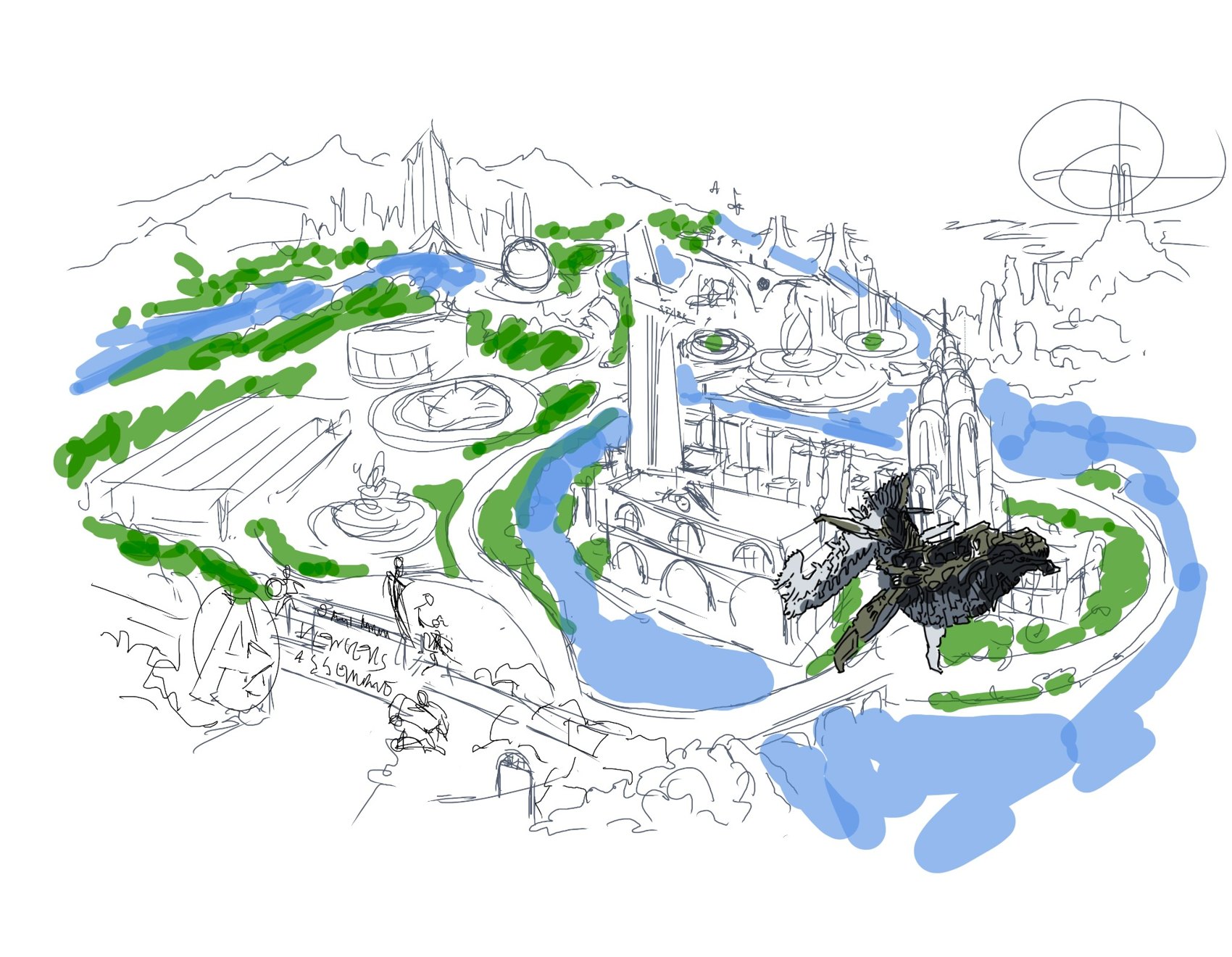
Finding the shape of the park / From an early spatial study to a more developed layout
Chapter 05 / Exploration
Following an idea into the details.
The deeper I went, the more questions I encountered.
How would guests be recruited for a mission—without breaking the existing narrative? What would the queue communicate before the attraction began? Where would humor provide relief from tension? How would a ride vehicle's movement support a particular story beat? What would guests see at the exact moment an attraction reached its climax? What signals would they receive when the mission was complete?
I began writing attraction narratives, dialogue, queue experiences, and scene-by-scene sequences. I sketched park layouts, guest perspectives, and possible ride moments.
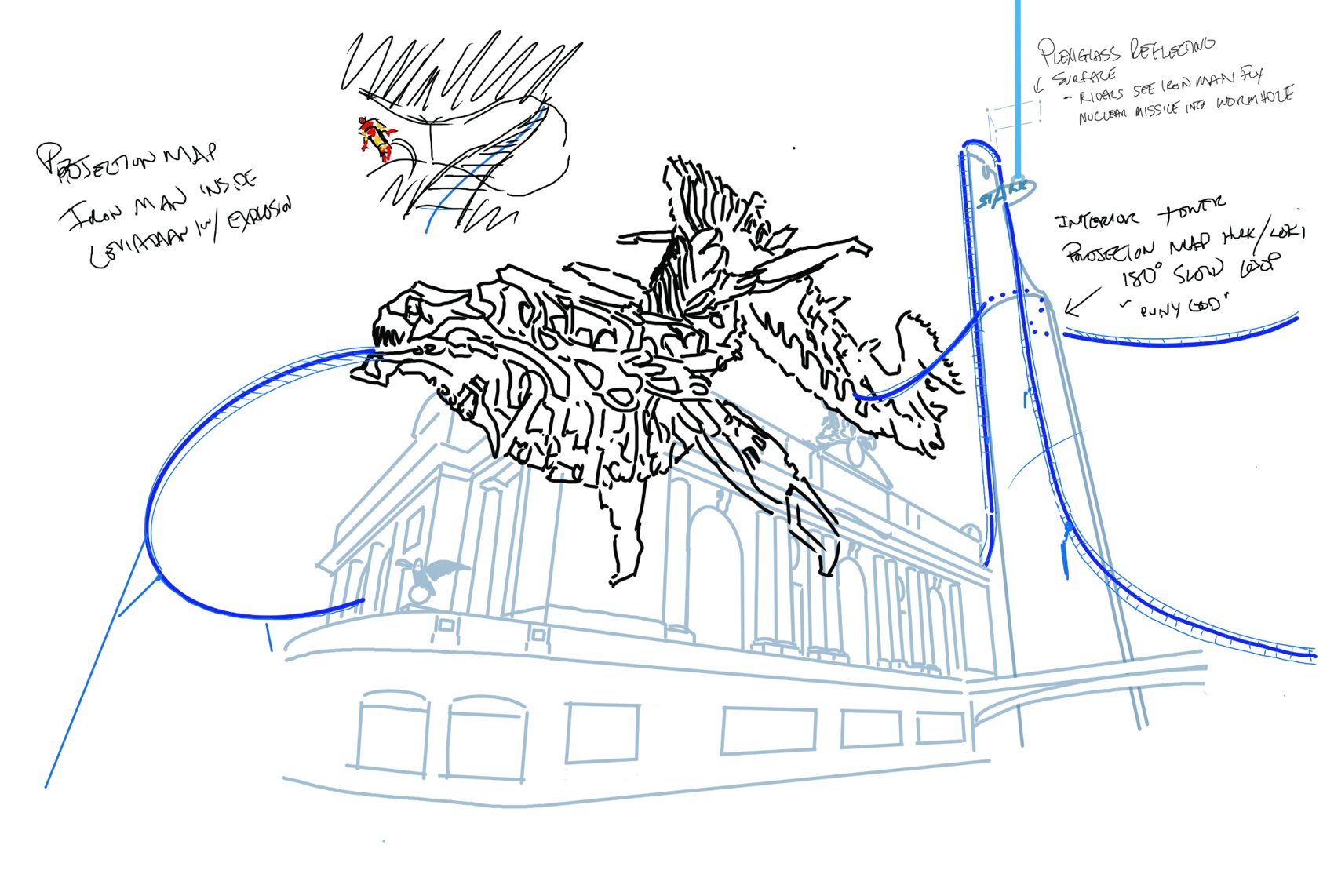
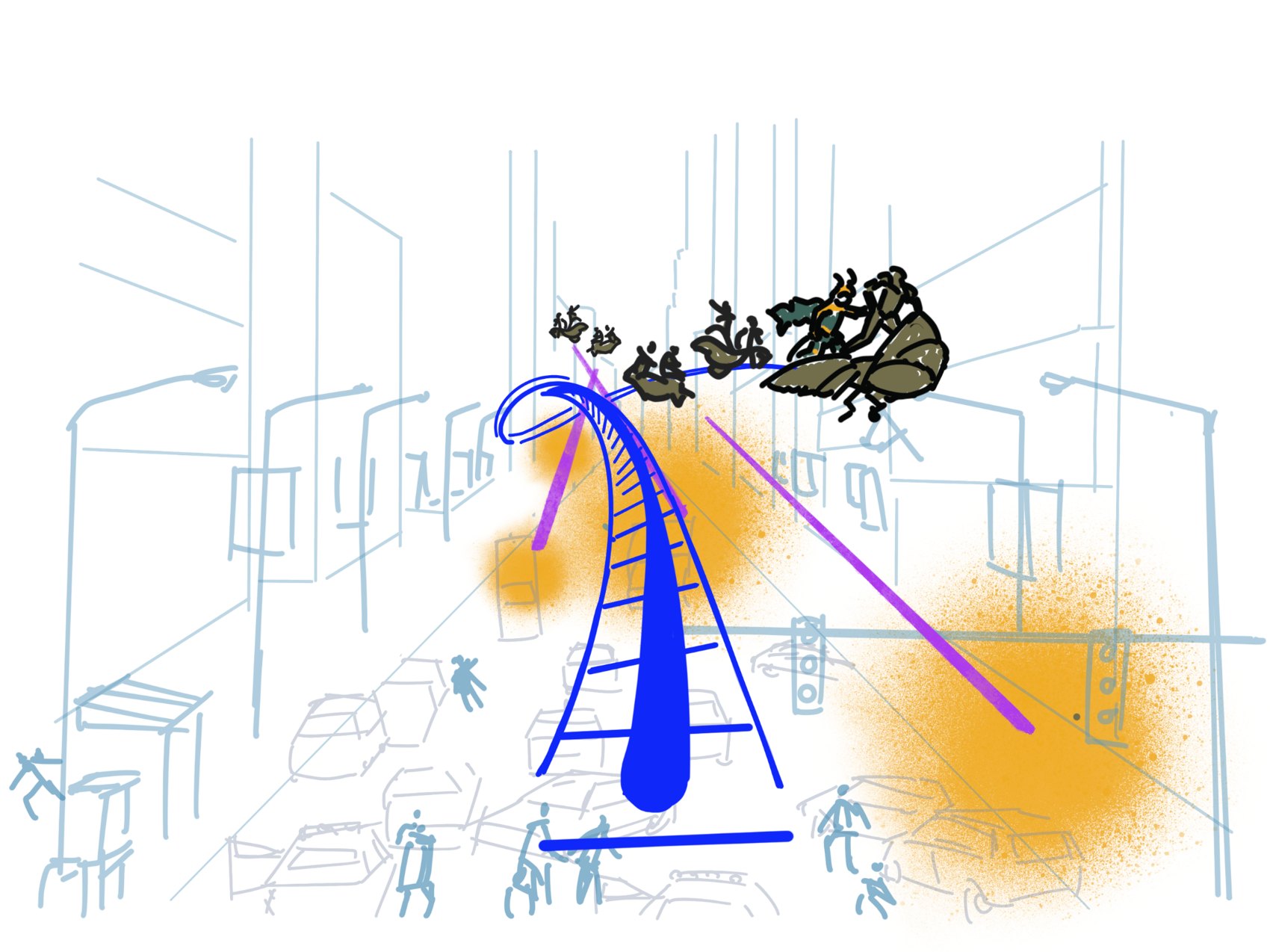
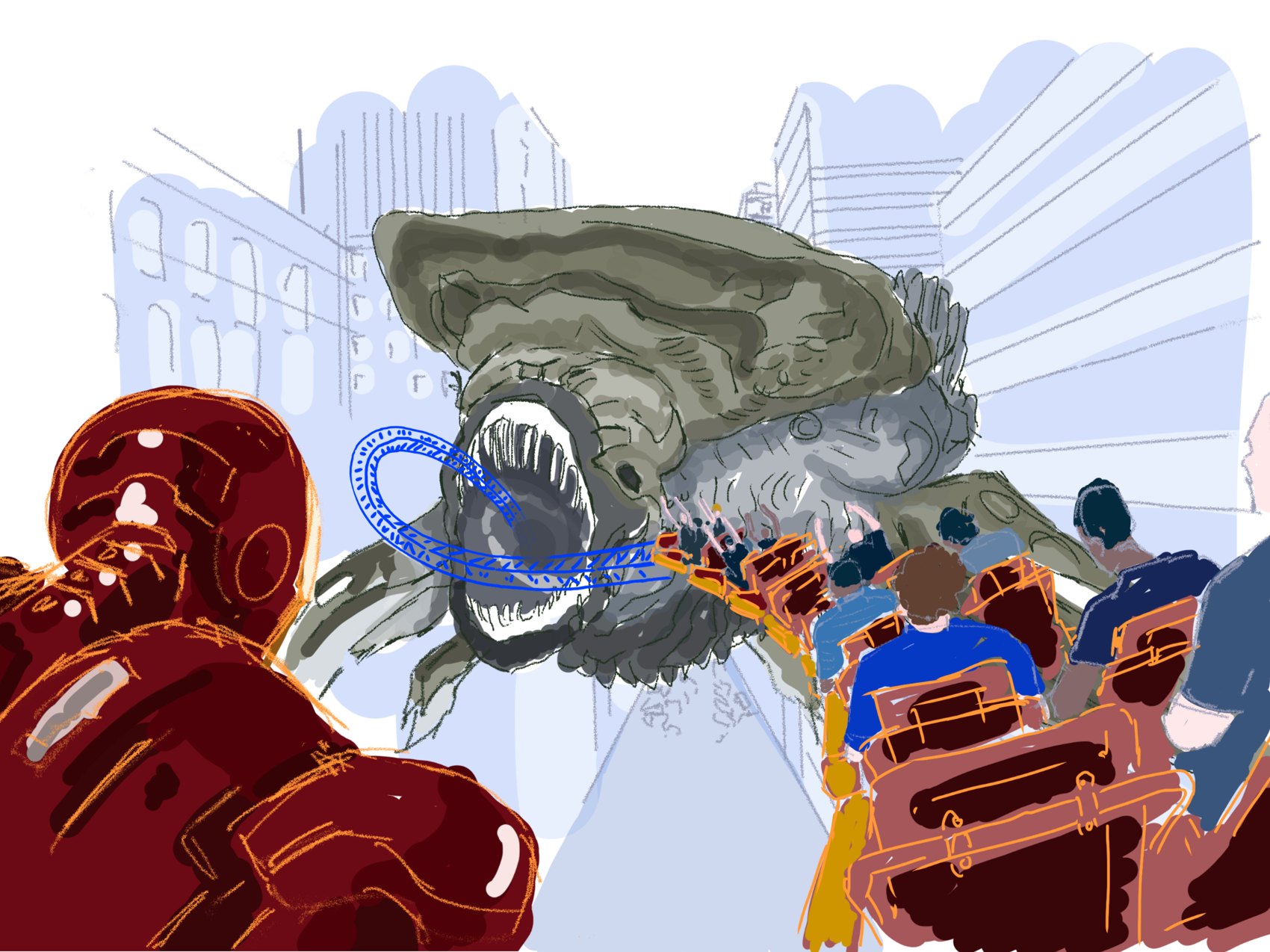
For the Battle for New York, I explored how a high-speed coaster might work together with carefully selected show scenes to put guests inside the invasion. My drawings considered everything from the approach to a Leviathan's enormous open mouth to the moment Iron Man carries a missile toward the wormhole above Stark Tower.
I also started asking practical questions about ride systems, capacity, physical space, and cost. No, I wasn't engineering a buildable attraction. That's clearly beyond my level of expertise. These were early explorations, and any idea I had would need substantial development and collaboration with specialists before it was proven out.
But I wanted to understand what my creative decisions might require in the real world. I wanted some sense of feasibility—if for no other reason than to put some real-world constraints on my runaway imagination.
My sketches aren't intended as finished concept art. They're tools for thinking—ways to explore movement, scale, perspective, timing, and the relationship between the guest and the story. Equally important, they're a means for me to take the pictures in my head and let other people see them for themselves.
And the writing isn't a finished production script. It's evidence of a process—sometimes messy, frequently revised, and driven by the desire to understand an experience more completely.
For me, the point wasn't to produce a convincing illusion of a finished park. It was to keep asking what this experience could be.
Could I take the most powerful film experience of my life, and translate it into an immersive, believable, real-life experience that was even better?
You better believe I'd try. I could do this all day.
Story meets movement / Leviathan sequence explorationRide movement and track exploration / Battle for New York
Exploring the guest perspective / Battle for New York
Chapter 06 / Reflection
What this project means to me.
I've spent much of my career designing experiences across digital products, visual media, and other platforms.
The tools and environments have changed, but the questions I ask have remained surprisingly consistent.
What does someone need to understand? What do I want them to feel? How do individual details support the larger experience? Where might confusion, friction, or inconsistency break the illusion?
Working on Avengers: Endgame Experience has given me a new way to explore those questions.
It's challenged me to think about physical space, movement, sensory storytelling, operational realities, and the many different ways guests might engage with the same environment.
It's also reminded me how much I enjoy learning something new.
This project is unfinished, and in some ways I hope it always will be. There are more questions to explore, more ideas to test, and more to learn from the people who actually bring experiences like these to life.
But I'm proud of how far a simple exercise has taken me.
I started with a story I've loved for decades.
Somewhere along the way, I discovered another story worth telling.
The story of the Imagineer who's been hiding inside the designer all along.
Coming next / Attraction focus
Battle for New York
A closer look at the attraction story, guest journey, coaster sequences, and sketches behind the Battle for New York experience.