What makes a place believable?
Not literally believable. Traction Yards isn't actually a turn-of-the-century Indianapolis neighborhood. The trolley cars aren't really coming back. The ghosts in the bakery windows aren't actually ghosts. The people walking through it know that.
And yet, if we've done our job correctly, for a few hours they won't care.
But what makes a place believable? That was the question that kept coming back to me as I worked on Traction Yards, a development concept being explored by Hendricks Property Group in downtown Indianapolis. Through Purdue University's themed entertainment program, I had the opportunity to work alongside other students and creative teams developing ideas for what this two-block urban development could become.
Coming from a background in continuity design, user experience and design systems, I'm naturally interested in the small things that make an experience feel coherent. A screen transition. A piece of terminology. A repeated visual cue. Things that may never be consciously noticed, but still affect whether the whole thing feels right.
Finally getting to apply that thinking to a 3-dimensional space made this an exciting project for me.
The project brief: create a contemporary outdoor recreation, retail and entertainment destination occupying the site of the former Circle Centre Mall, with a strong connection to Indianapolis history.
The client provided multiple examples of successful outdoor mall spaces, sharing his likes and dislikes - but what he was really looking for was something that would make this experience different than any of the countless others. Indianapolis attracts tens of millions of visitors each year, many arriving for a sporting event, concert or convention, then leaving the following day. The client wanted to create a destination that could give those visitors a reason to extend their stay.
That distinction stayed with me. A beautiful public space or an appealing amenity might make a visit more enjoyable. But what would be the thing that draws them there in the first place? What experience could we offer here that they couldn’t get anywhere else?
How do you make a modern urban development feel distinctly Indianapolis?
Not just by putting some historic architecture on the buildings. Not by hanging an old photograph on a wall. And not by creating a museum where people stop and read about what used to be here.
What if the history could actually become part of the experience?
That question became the beginning of my work on Traction Yards.
Finding the story
The first thing I went looking for was a story.
Not a fictional one, at least not initially. I wanted to understand what made Indianapolis unique at the moment in history we were trying to evoke.
That research kept leading me back to transportation.
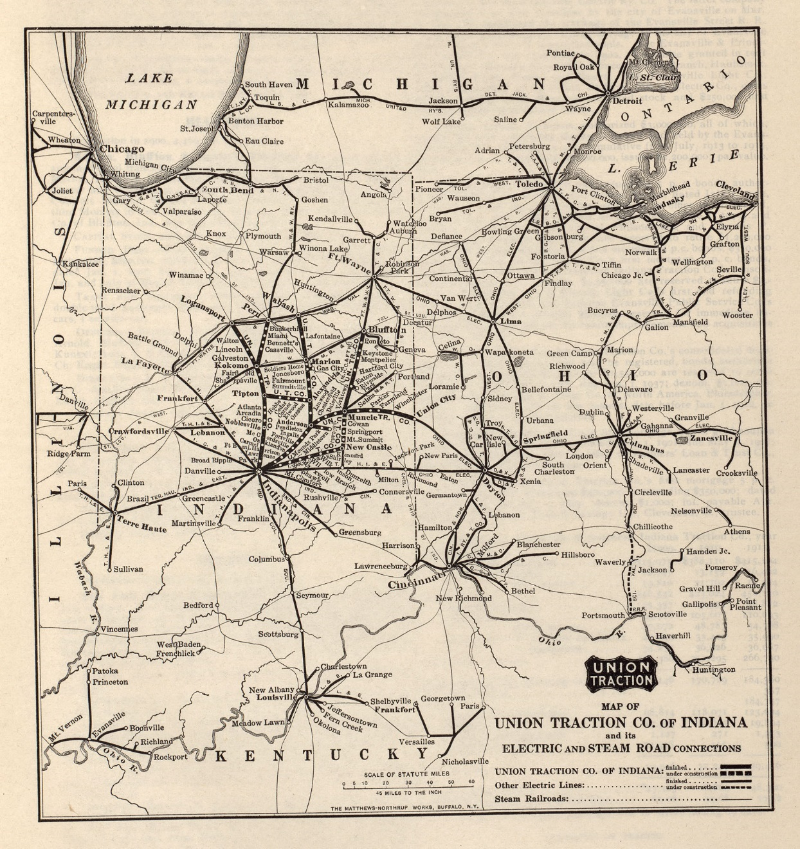
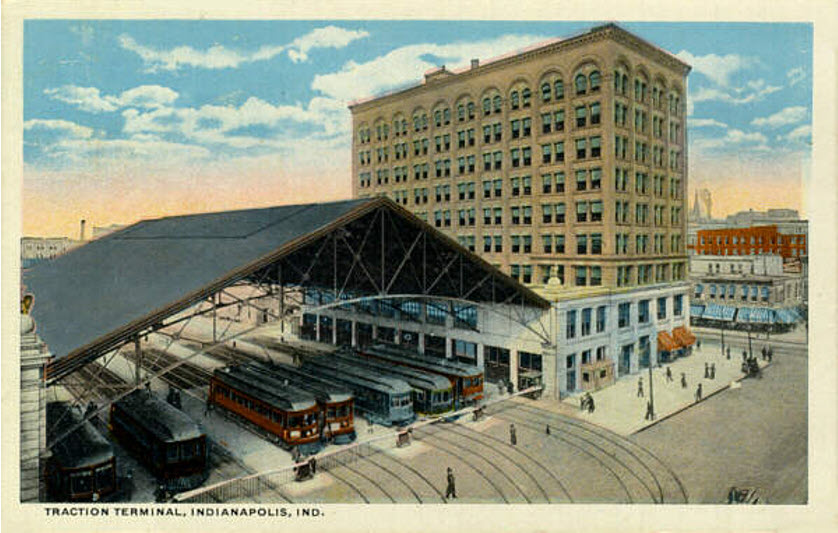
At the beginning of the twentieth century, Indianapolis was a crossroads. Electric streetcars and interurban railways connected the city to communities throughout Indiana and the Midwest. The Indianapolis Traction Terminal became one of the great hubs of that system.
The city - and its people - thrived because of the rail car system.
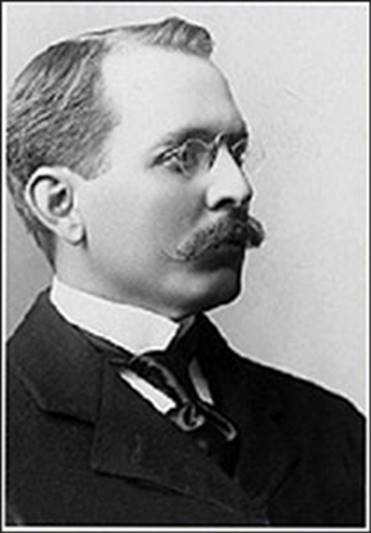
And then I discovered Samuel Insull.
He began his career as Thomas Edison's secretary and went on to become one of America's most powerful electrical industrialists. He believed electricity should become broadly accessible, and he saw an opportunity to connect electric utilities with electric railways in a mutually reinforcing system.
When Indiana's interurban network began collapsing under pressure from automobiles, highways and the Depression, Insull didn't simply accept that the system was obsolete. He bought failing traction companies, consolidated them, modernized their infrastructure and invested in new rolling stock.
For those who'd come to rely on it, and prosper from it, he was the last man standing between the transit system and a complete change to their way of life.
And then it all collapsed.
His business empire failed during the Great Depression. His reputation was destroyed. His fortune disappeared. He eventually died broke in a Paris metro station.
Depending on who you ask, Insull was a visionary, a monopolist, a forefather of infrastructure, a robber baron, a financial architect, a champion of the working class, a victim of circumstance—or some complicated combination of all of them.
That ambiguity interested me.
Because I didn't need Insull to be a hero.
I needed him to be interesting.
What if the past didn't want to disappear?
That led me to a more speculative question.
What if Insull's unfinished vision became the supernatural force behind the nighttime experience?
Not a hologram of Samuel Insull standing on a stage and giving a speech. Who’d listen?
Instead, his idea could survive.
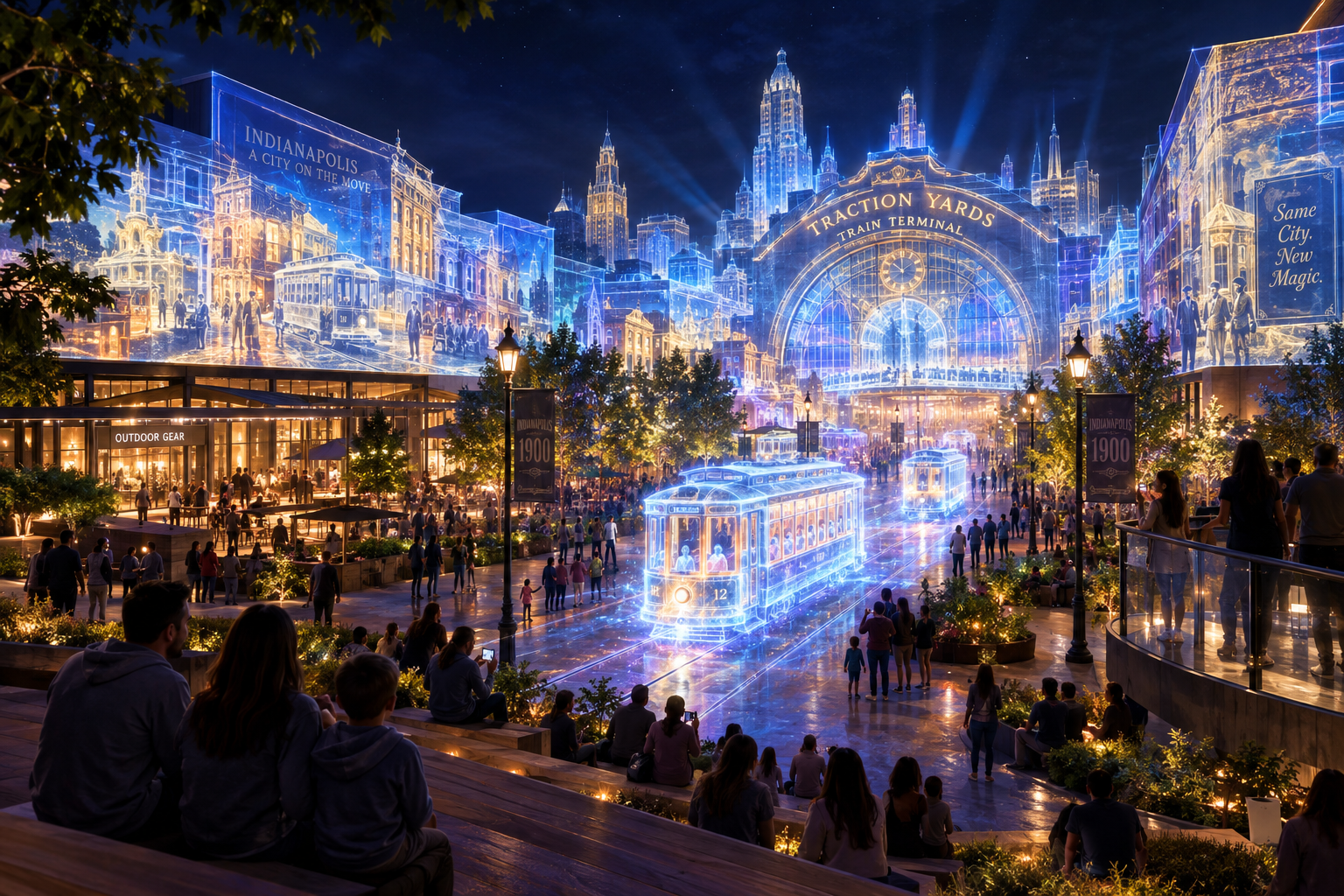
At night, the infrastructure of Traction Yards could begin to reveal another layer of itself. Trolley tracks beneath the pavement would illuminate. Historic routes would appear. Ghostly electric cars would materialize along the main thoroughfare. Passengers would appear in shop windows, waiting for their train. A trolley might disappear into the crowd only to reappear moments later somewhere else.
The architecture itself could seem to remember what it once was.
Suddenly, the conflict wasn't really old versus new.
It was the old refusing to become irrelevant.
And that felt much more interesting.
Because Insull's story wasn't really about wanting to turn the clock backward. He spent much of his career trying to modernize the systems he believed in.
Maybe his ghost wouldn't be asking us to bring the past back.
Maybe he would be asking us:
What happens when progress moves so quickly that we forget what we're leaving behind?
That question gave the history somewhere to go. It also suggested that the story couldn't live only inside a nighttime show. If the past was going to refuse to become irrelevant, it needed to exist in the place itself.
From story to place
This is where the project team collaboration kicked into high gear.
I had been focused primarily on the show and the question of how to bring the historic rail system to life at night. But as we iterated as a team, it became clear that the story couldn't belong to the show alone.
A team member was thinking about the larger environment in a way that expanded the idea considerably: what if the sense of history wasn't confined to a single attraction, but was woven throughout the property?
“Old brick and limestone could meet contemporary glass. Preserved ghost signs could sit alongside new elements. Painted brass could exist beside digital signage. Trolley tracks could run beneath people's feet while landscaping softened the industrial materials."
That changed the way I was thinking about the project. The idea of Traction Yards as a place that had evolved over time became a useful way to think about everything else.
The place didn't have to look like it had been built in 1905. It could feel as though it had been accumulating layers ever since.
The architecture could carry the history. The nomenclature could carry it. The retail and food concepts could carry it. The technology could carry it. And the nighttime show could take all of those ideas and make them come alive.
My contribution became less about defining what every corner of Traction Yards should look like and more about connecting the narrative to the experiential moments I was developing—making sure the show had a believable relationship to the place surrounding it.
That distinction is important to me. Good creative collaboration isn't everyone having their fingerprints on everything. It's knowing when to lead, when to contribute, when to challenge, and when someone else's idea is simply better.
The Grand Concourse
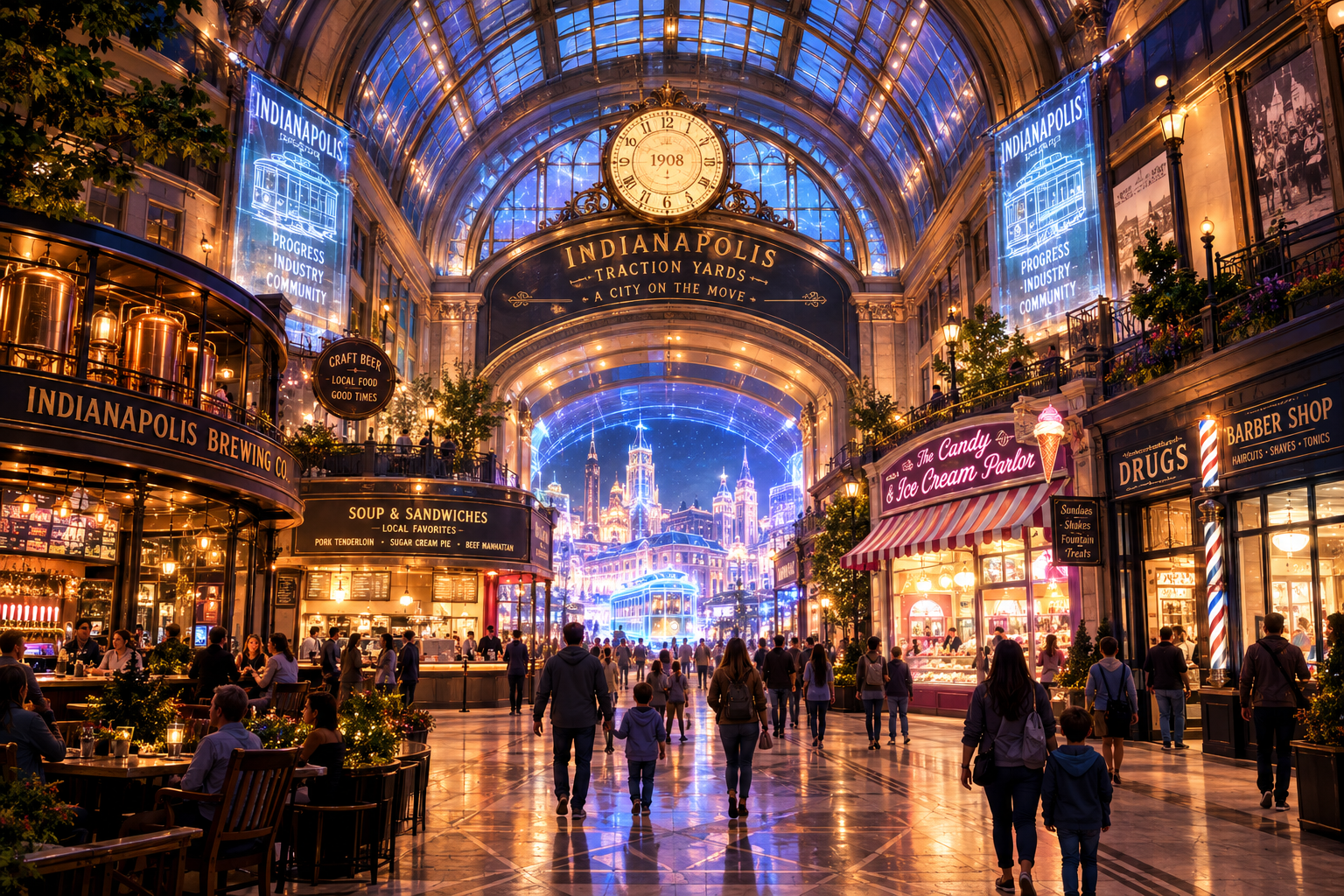
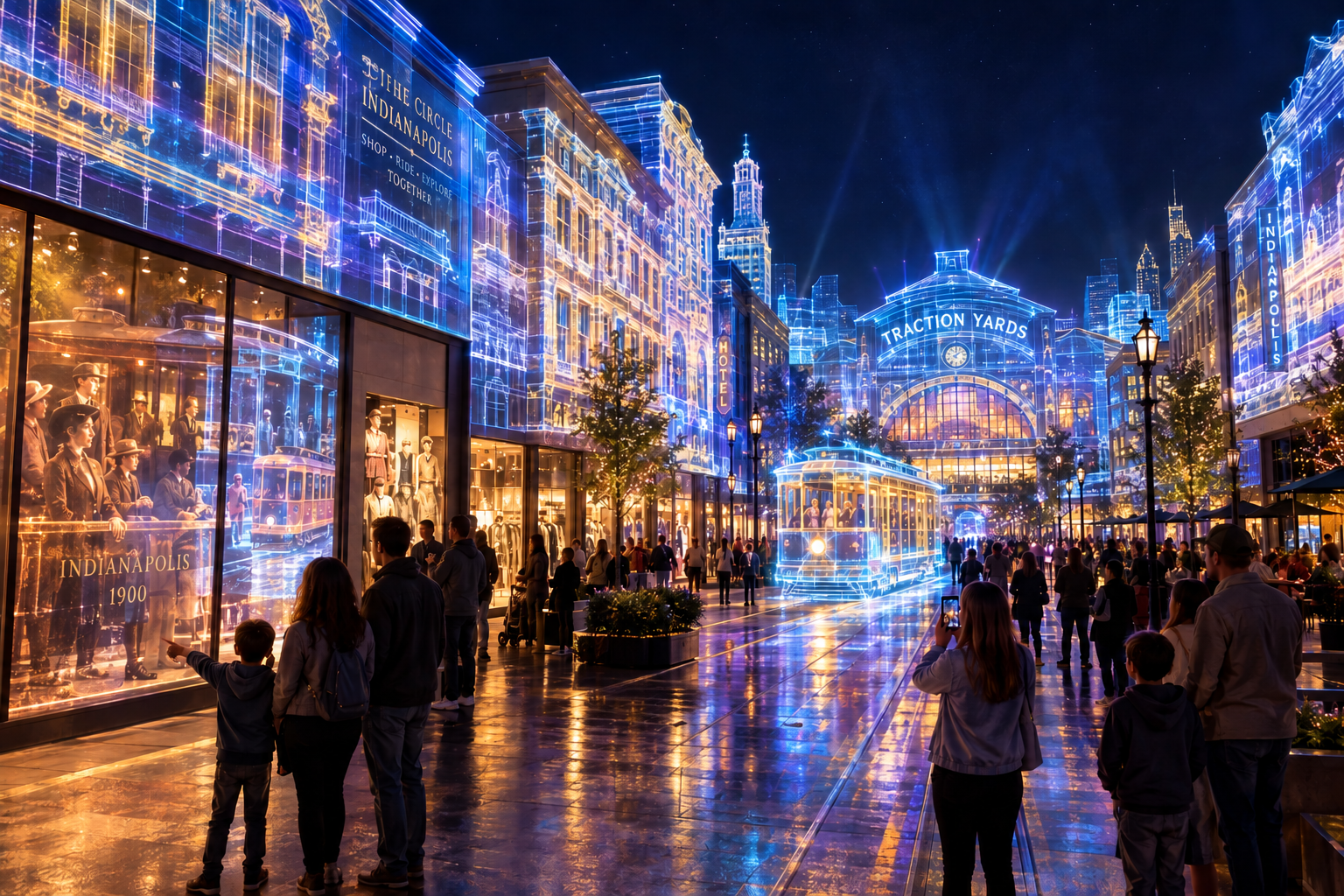
The entrance visualization was developed from an AI prompt incorporating the team’s ideas for historic-inspired shops and the feeling of arrival in a grand railway station.
The concourse is meant to be stunning—a grand architectural threshold that immediately tells you you've arrived somewhere different. From the street, guests catch a glimpse through the large archway opening: warm light, historic-inspired architecture, storefronts, activity and just enough mystery to make you want to see what's beyond it.
In a themed experience, that transition matters. You're quite literally moving from the everyday world into the world we've created for you. The concourse becomes the station platform, the gateway, the first step in the journey.
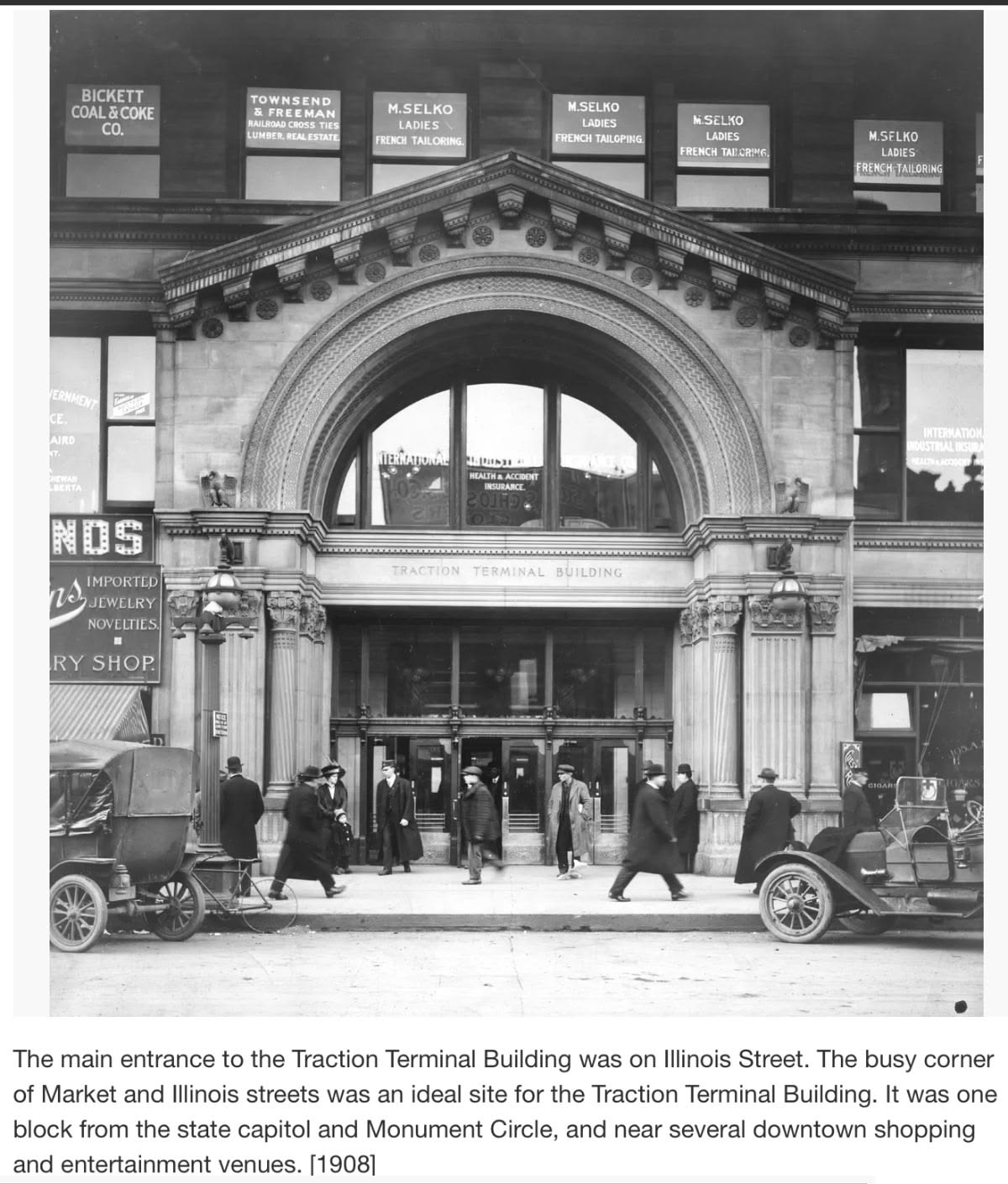
You don't need a long explanation. You just see the destination waiting on the other side of the archway.
Get your ticket. Hop on board.
Once the environment started to feel like a place with its own history, the next natural piece of the puzzle was language. That eventually produced a shared vocabulary for the development.
We didn't need a restaurant when we could have a Sandwich Shop or Lunch Counter. A bar could become a Saloon, Tap Room or Rathskeller. A clothing store could become a Clothier or Outfitter.
Directions didn't have to be “turn right at the corner.” They could become Tracks, Lines, Connections, Limited, Local and Express. Even the parking lot could become a destination for Motor Cars.
These are tiny details. Most guests won't consciously notice them.
That's exactly the point.
The world doesn't feel believable because someone explains it to you. It feels believable because everything seems to agree with everything else.
And once that vocabulary was established, it became easier to start asking the same question about the things people would actually do there.
The Switchyard
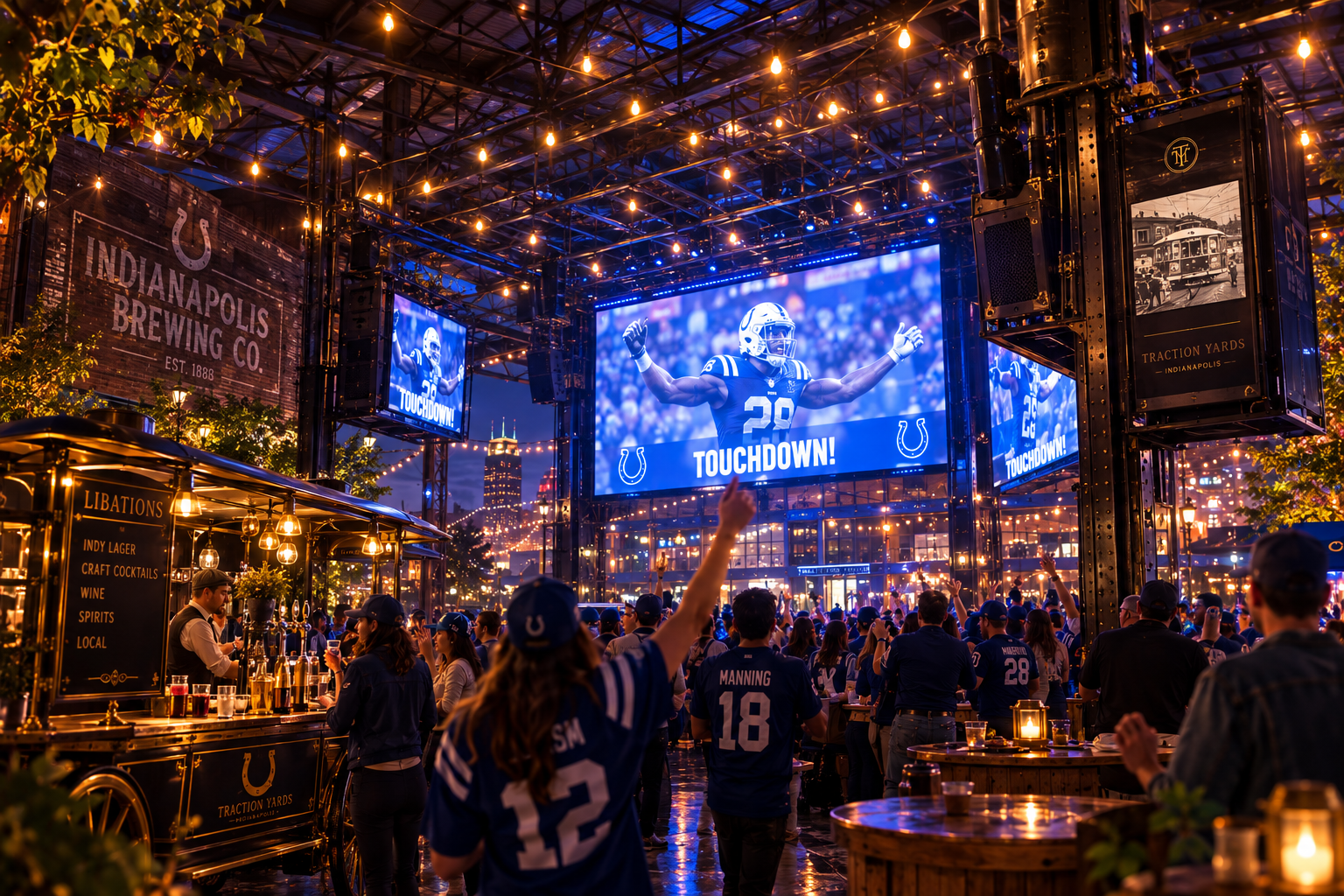
The Switchyard visualization translated a collaborative brief for a flexible civic gathering space into a historically informed visual concept.
We developed The Switchyard as the social heart of Traction Yards—a contemporary interpretation of the historic traction-yard aesthetic, but deliberately more open, green and park-like.
During the day, it could simply be a beautiful place to sit, eat, work and gather. At night, it could become something else entirely.
The architecture takes cues from historic Traction Yard structures: steel trusses, riveted housings, exposed conduit, industrial materials and warm lighting. Modern broadcast screens are integrated into that vocabulary rather than simply bolted onto it - and look as natural as a pop-up stage and a live performance.
A sports broadcast doesn't suddenly transport guests into a completely different visual world. The technology itself belongs there. Layered.
A rolling libation cart can look as though it might have been designed for the space a century ago. A contemporary event can happen beneath architecture that feels like it has been there for generations.
The past isn't decoration.
It's the design system.
Giving the trolley another life
The trolley became one of the most useful pieces of the puzzle. It was already an icon of the story. But that raised another question: what should an icon actually do?
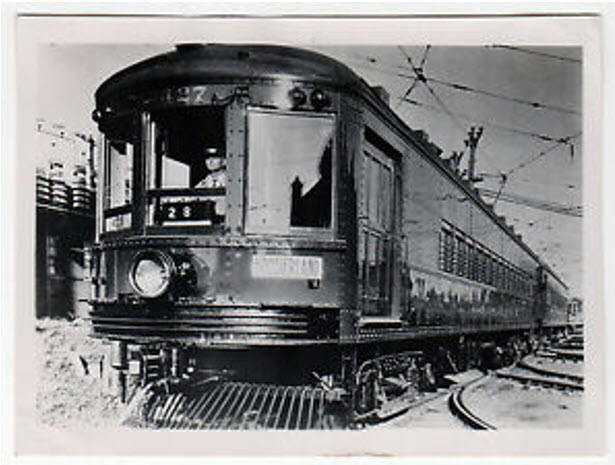
Rather than treating an old trolley as a museum artifact, what if we gave it a new job?
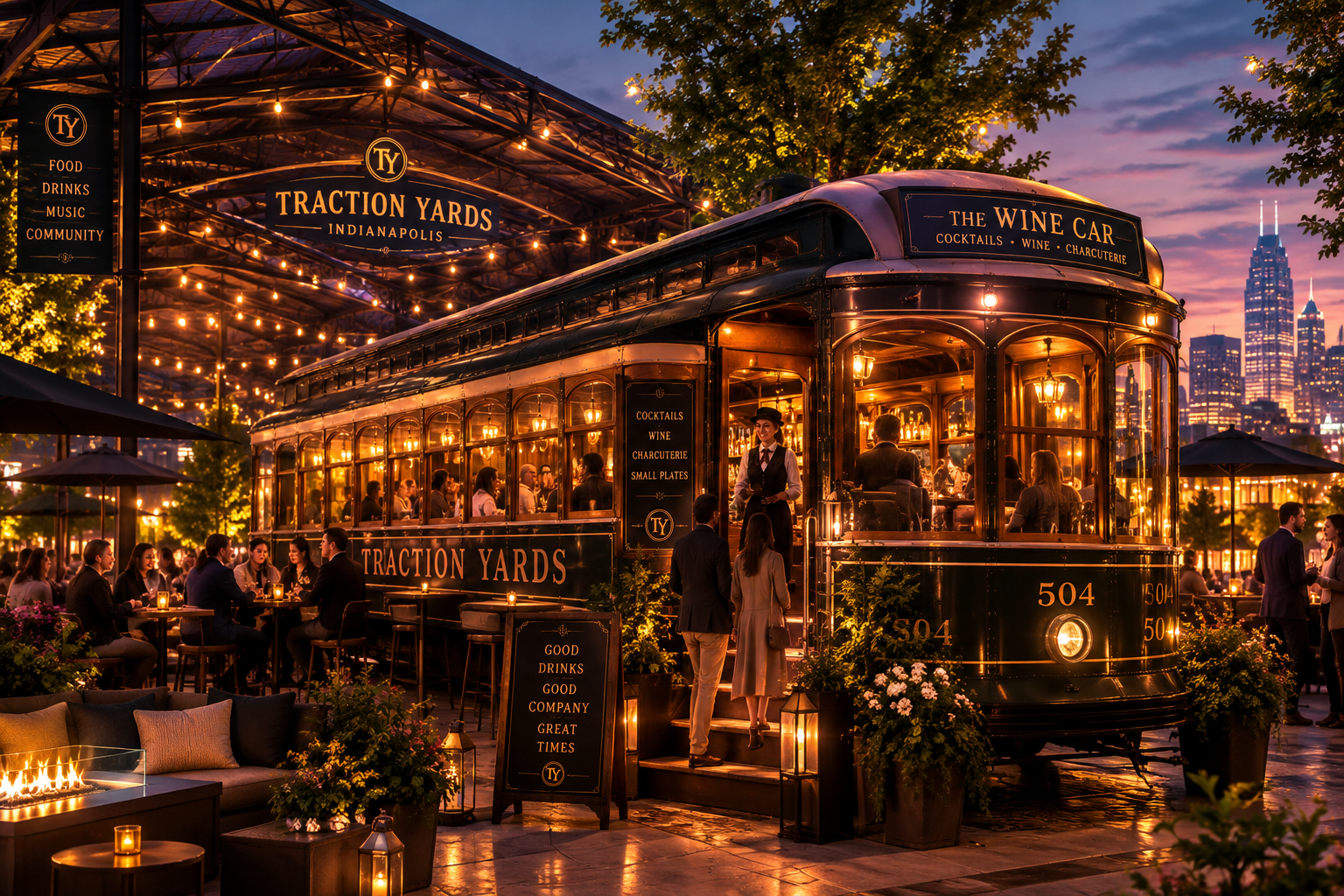
A trolley could become a coffee shop. A welcome center. A sweet shop. A flower shop. A children's discovery space.
Or, in one of my favorite ideas, a cocktail, wine and charcuterie car—a little piece of rolling stock repurposed into a contemporary destination.
That idea felt very Traction Yards to me.
Because it wasn't pretending the past still existed.
It was asking:
What if the past could be useful again?
Then the lights went out...
All of those layers made the experience less dependent on the nighttime experience - but the biggest opportunity was still at night.
I wanted Traction Yards to have a moment when the entire place could transform.
Not a fireworks show. Not a projection mapping spectacle for spectacle's sake. Something that was intrinsically connected to the identity of the place. Something uniquely Indianapolis.
And something that could become a reason to visit in its own right.
A distinctive nighttime experience, rooted in Indianapolis’s own history, might give visitors something to plan an evening around. The show could become a reason to visit. The larger environment—and the amenities and experiences contained within it—could become a reason to stay.
That became Echoes of the Past.
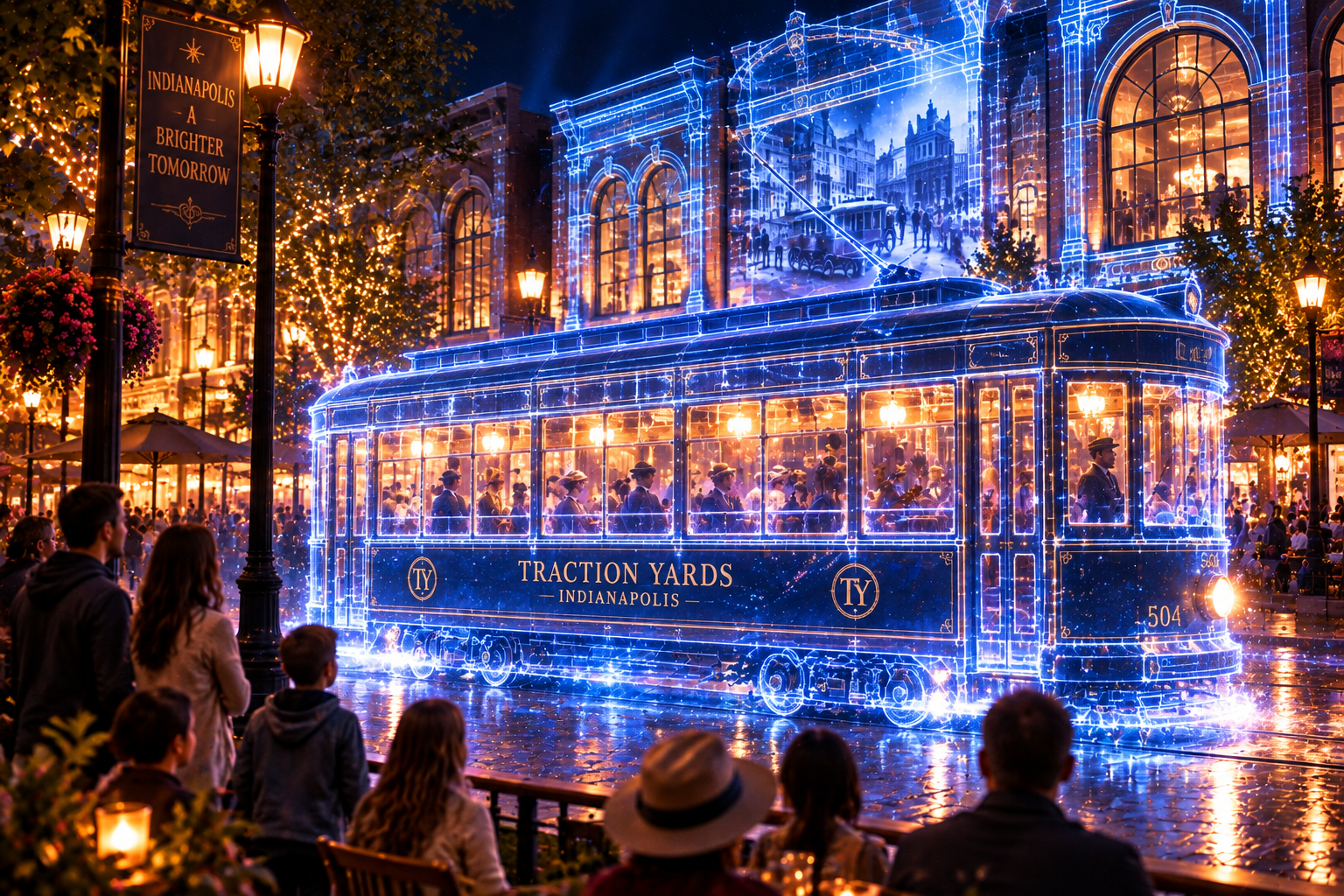
The idea is simple enough: at night, the old electric rail system begins to come alive.
Projection mapping transforms the building facades. Historic trolley routes glow beneath the streets. Ghostly electric cars travel the main thoroughfare, passing right through the crowds.
And then the details get stranger.
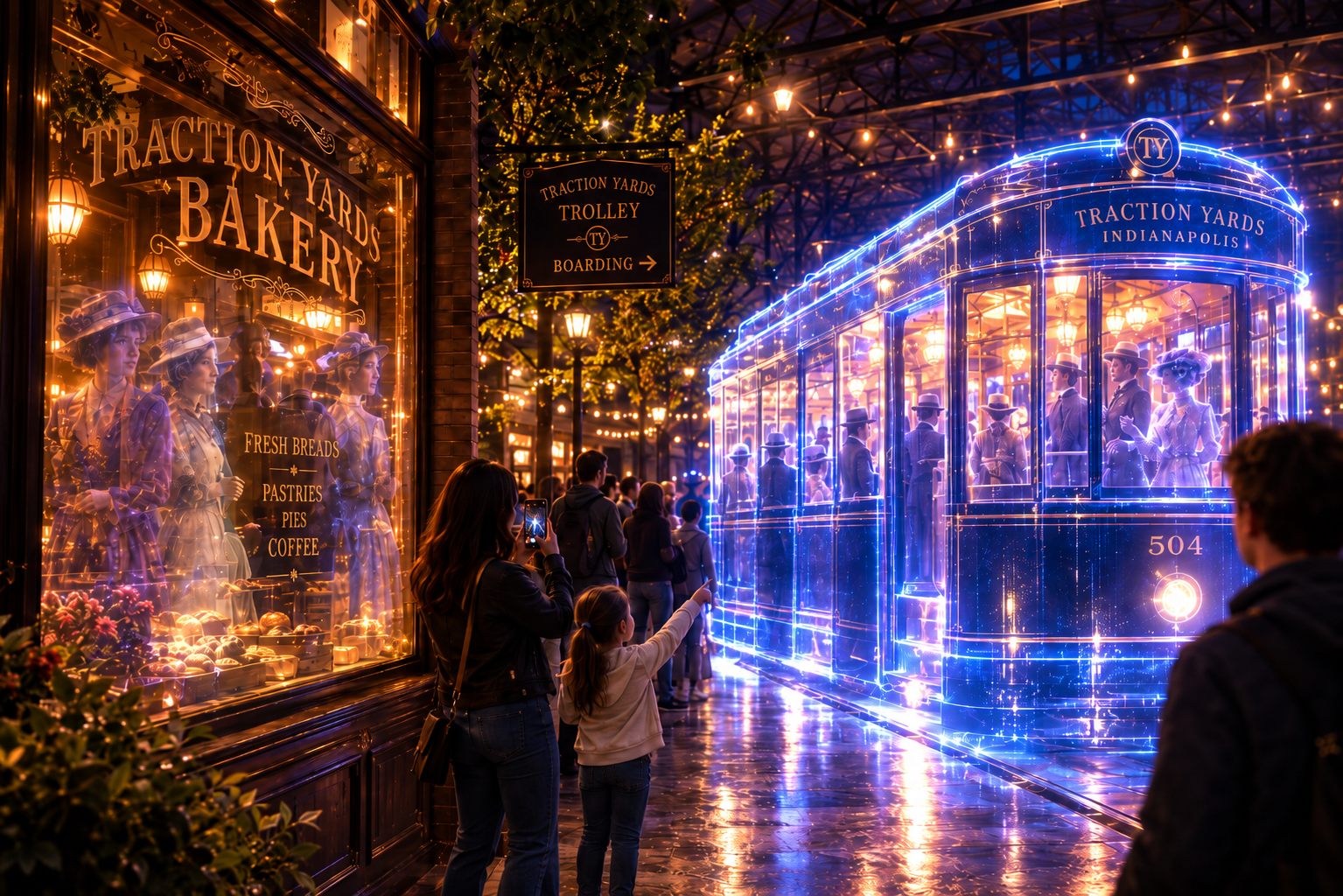
Guests might look through the window of a bakery and see a group of women in period dress waiting for their train.
They aren't statues. They aren't video screens. Using a Pepper's Ghost-style illusion, they appear almost physically present inside the storefront.
One by one, or in pairs, they leave the station. They seem to disappear as they encounter the modern crowd. And then, moments later, they reappear within the boundary of the projected trolley and board.
The effect isn't intended to frighten anyone.
It's an echo.
A moment when two versions of Indianapolis occupy the same space.
The story has to survive the show
This is where the whole project just clicked for me.
It would have been relatively easy to design a spectacular nighttime show.
It would have been harder to make the entire property feel like the same story.
That's where my background in continuity design, user experience and design systems started to become useful.
In digital products, I've always been interested in the things users may never consciously notice: the way an interaction behaves, the way one screen transitions into another, the consistency of terminology, the small details that establish a sense of quality.
The same principle applies to physical environments.
If the show tells me that Traction Yards is an old transportation hub, but the restaurant menus, signs, architecture, wayfinding and technology all feel like they belong to completely different worlds, the illusion breaks.
But if the signage, architecture, food concepts, lighting, language, retail, technology, entertainment and story all reinforce one another, something different happens.
The guest stops evaluating each individual element.
They simply accept the world.
Continuity sells the story
This, ultimately, became the idea I found myself returning to throughout the project.
Story gets people interested. Continuity makes them believe.
The guest doesn't need to know that Track is being used instead of way because of a carefully developed nomenclature system.
They don't need to understand why the broadcast screens are housed in riveted steel. They don't need to know why there are trolley tracks beneath their feet. They don't need to understand the historical significance of the architecture. And they certainly don't need to know who Samuel Insull was.
They just need to feel that everything belongs.
That's the same principle I learned working in digital products: a user may never be able to tell you why an interface feels polished, but they know when it does. Every interaction reinforces the last one. Every detail supports the same underlying system.
Traction Yards is essentially a physical interface.
The guest is the user. The environment is the product. And the story is the system holding it all together.
Becoming part of the next layer
The team's theme statement for this project really captures what it's all about:
Traction Yards isn't really about recreating the past.
It's about what happens when we inherit the past.
Previous generations left behind buildings, businesses, transportation systems, craftsmanship, signs, traditions and gathering places. Some survived. Some disappeared. Some were given entirely new purposes.
Now it's our turn.
What we preserve, reuse, reinvent and create today will eventually become someone else's history.
Someone else's nostalgia. Someone else's echoes of the past.
That is why I think the best immersive experiences don't simply tell us a story.
They give us the feeling that we have stepped into a story that was already happening—and that, for a little while, we get to decide what happens next.
For Traction Yards, my role has been less about creating any one individual piece and more about helping those pieces belong to the same world.
I'm not the architect. I'm not the fabricator, mechanical engineer, projection designer or illustrator.
I'm the conductor.
My job is to find the connections, establish the rhythm, and help all of those different disciplines move in the same direction.
Because when the story, the environment and the experience are all telling the same story, the guest doesn't have to work very hard to believe.
They can just enjoy the ride.